

When Lewis Pest Control offered a 12-month guarantee on their bat removal service, I felt reassured, until I started noticing fresh bat guano on the attic floor again. I never heard them, never saw them, but the droppings were unmistakable. Something was still getting in.
That left me with two choices: climb into the attic regularly in the summer heat to check for new signs, or build a system to monitor it for me.
So I decided to take a different approach, one that didn’t involve a flashlight and a ladder.
A Tech-Powered Stakeout
I had two big questions:
- Were bats still entering the attic?
- If so, how are they getting in?
The heart of the solution was the Ultramic192K_EVO USB microphone, a high-sensitivity device capable of recording ultrasonic audio up to 192 kHz, well beyond the range of human hearing. It’s commonly used for monitoring wildlife, especially bats, whose echolocation calls fall between 20 and 120 kHz.
To complement the audio monitoring, I installed several night vision cameras, some with motion detection, aimed at likely entry points and along the attic rafters. These cameras streamed live feeds over RTSP (Real Time Streaming Protocol), which allowed me to record them continuously to disk in a circular buffer format.
For this, I used a Raspberry Pi 5 with 8GB of RAM, a compact but capable board that could handle multiple simultaneous streams and manage buffered video storage without overheating or breaking the budget.
The Ultramic was mounted on a rafter and connected to a low-power mini PC running ultrasonic recording software.
Seeing What You Can’t Hear
Since I couldn’t hear the bats myself, I turned to Audacity. Its spectrogram view displays sound visually over time and frequency. Bat echolocation calls appeared as short, bright “blips” in the 25–40 kHz range, each one lasting just a few milliseconds.
Not only did this confirm activity in the attic, it also helped me identify the species. The frequency range and structure of the calls matched those of big brown bats (Eptesicus fuscus), which are common in the area.
Linking Audio to Video with Python
Once the Ultramic picked up an echolocation call, I wanted to visually verify the event. I wrote a Python program that monitored the ultrasonic recordings in real time. When bat activity was detected, it sent a signal to the Raspberry Pi, which was maintaining a rolling cache of the RTSP video feeds.
The script would automatically pull video starting 5 seconds before the echolocation timestamp, saving a clip of the bat’s approach, entry, or flight path. This made it possible to capture clear video evidence of the bats, even when I wasn’t watching in real time.
Finding the Entry Point
With several confirmed sightings, a pattern emerged. One bat consistently entered from the northeast gable, looped once under the rafters, and exited minutes later. Thanks to the synced audio and video setup, I narrowed the entry point down to a small gap between flashing and siding, something that would’ve been nearly impossible to find manually.
Lewis Pest Control, honoring their 12-month guarantee, came out and did the exclusion for free by targeting the exact spot I had identified. No unnecessary sealing, no attic crawling, no hassle.
Filtering Out the Noise
As summer arrived, I ran into two new problems:
- Heavy rain on metal roof sections triggered sharp ultrasonic spikes.
- Cicadas flooded the spectrum with long, droning signals that muddied the data.
Because bat echolocation calls are so short, typically under 20 milliseconds, I tuned the system to ignore events longer than 20–30 ms, filtering out both weather and insect noise effectively. This restored the accuracy of the detections.
Results That Paid Off
With this homegrown, tech-enabled monitoring system:
- I confirmed active bat presence without entering the attic.
- I identified the species using ultrasonic frequency data.
- I captured synchronized video evidence automatically via Python and the Raspberry Pi.
- I stayed fully covered under the 12-month pest control guarantee, backed by timestamped proof.
- And I got hands-on experience with bioacoustics, real-time video buffering, and creative problem-solving.
The bats are gone. The entry point is sealed. And the system is still in place, quietly listening and watching, ready if they ever return.
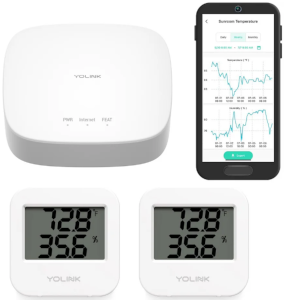 Use YoLink temperature sensors to monitor and document room conditions in your office or apartment building, perfect for proving HVAC issues to landlords or managing properties remotely. With a low-cost hub and sensor setup, real-time alerts, and long-range LoRa wireless, YoLink is ideal for commercial buildings. Expand with leak detectors, motion sensors, smart plugs, and more for a full smart monitoring system.
 Think AI is too complex or expensive for your business? Think again. This post breaks down three simple, practical ways local companies are using AI right now, like answering phones, managing email, and scheduling appointments. If you’re curious but cautious, this is a great place to start.